




- Università: Luigi Bocconi
- Docenti:
Laxminarayana Yashaswy Akella
- Studenti:
Camilla Cozzi, Arianna Di Carlo, Alessandro Donnini, Valentina Erario, Roselena Martiniello, Emma Romano
Gruppo - Glow gang
video: https://youtube.com/shorts/XQzrDjBTH8w?feature=share
Match è una piattaforma di eCommerce innovativa, nata per trasformare il modo in cui i consumatori scoprono, comprendono e acquistano prodotti per la cura della pelle. Non si propone come un semplice negozio online, ma come un ecosistema digitale intelligente, educativo ed etico che unisce intelligenza artificiale, trasparenza sugli ingredienti e una selezione curata di brand in un’unica esperienza coerente.
L’idea nasce in risposta alla crescente complessità del mercato skincare, in cui i consumatori si trovano di fronte a un’offerta enorme di prodotti, promesse pubblicitarie aggressive, tendenze lanciate dagli influencer e informazioni spesso contraddittorie su ingredienti e routine. Allo stesso tempo, gli italiani sono sempre più attenti alla composizione dei cosmetici, alla sostenibilità e alla personalizzazione, e cercano chiarezza e affidabilità nelle proprie scelte d’acquisto. Match nasce proprio per rispondere a questa esigenza: colmare il divario tra tecnologia, educazione e consumo consapevole, aiutando ogni persona a costruire una routine di skincare informata, efficace e sostenibile, trasformando il semplice “shopping” in un percorso di auto-cura consapevole.
Il mercato italiano della skincare rappresenta un terreno fertile per questo modello. Le proiezioni indicano una crescita stabile e resiliente, con un giro d’affari che dovrebbe sfiorare i 3,8 miliardi di dollari entro il 2030, sostenuto da una domanda costante e da una maggiore attenzione alle routine e agli ingredienti. Parallelamente, il canale digitale continua a espandersi: entro il 2030, gli acquisti online dovrebbero rappresentare circa il 37% del totale. MATCH si inserisce in questo contesto con un mercato potenziale di circa 36,5 milioni di consumatori skincare in Italia, dei quali circa 6 milioni già acquistano online. L’obiettivo è raggiungere 12.000 utenti attivi ricorrenti entro tre-cinque anni.
Un posizionamento speccifico
Match si distingue dai player esistenti grazie a un posizionamento integrato e distintivo. I grandi retailer online come Douglas, Notino o Amazon Beauty offrono varietà e convenienza, ma poca personalizzazione e valore educativo. Le app che analizzano gli ingredienti garantiscono trasparenza, ma non consentono l’acquisto diretto né un’esperienza su misura. Le soluzioni Ai dei grandi brand, invece, offrono strumenti diagnostici ma restano limitate ai prodotti di quel marchio. Match unisce ciò che finora è rimasto separato: analisi della pelle con intelligenza artificiale, educazione sugli ingredienti e confronto indipendente tra diversi brand, tutto in un unico ecosistema.
In questo modo si posiziona nel livello più alto per sofisticazione tecnologica e trasparenza, diventando un vero e proprio “compagno intelligente” nella cura della pelle, che punta su fiducia ed etica invece che su sconti o ampiezza di assortimento.
L’esperienza utente
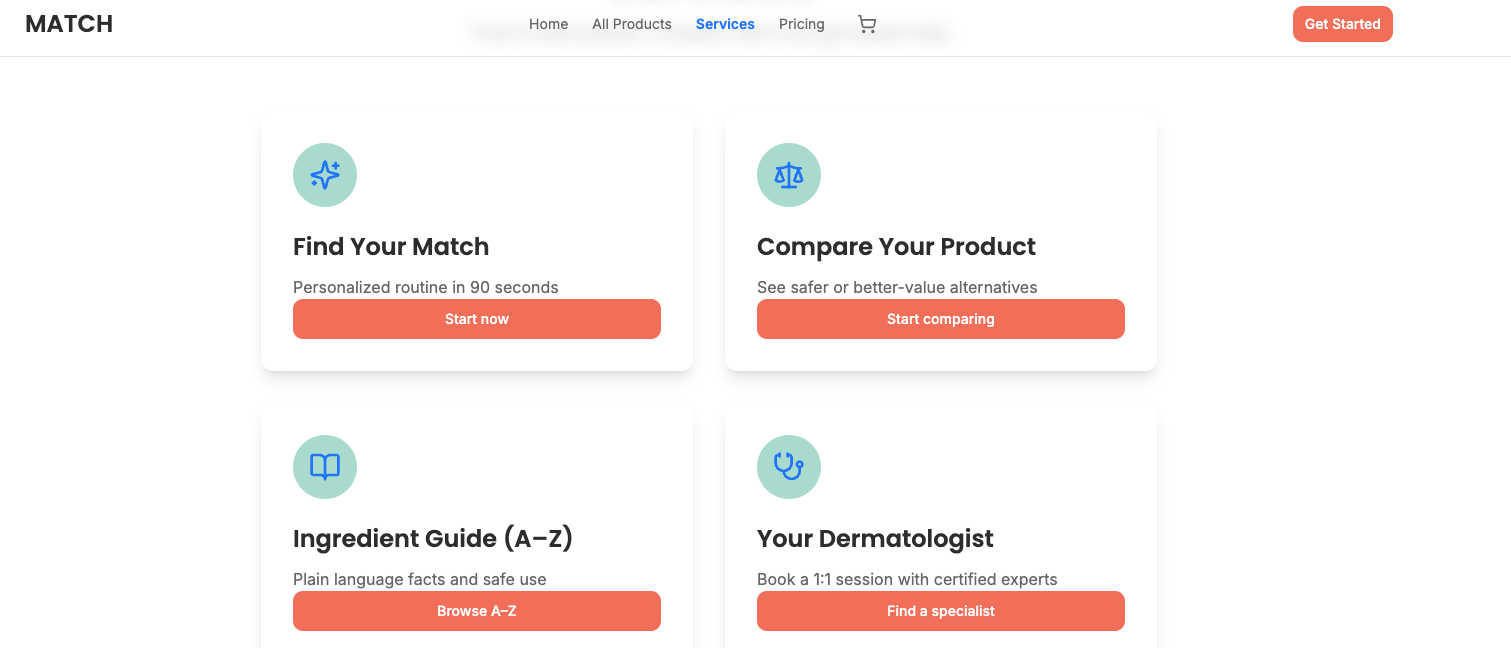
Il percorso utente riflette questa filosofia. Tutto parte dal riconoscimento di un’esigenza — come acne, secchezza, sensibilità o segni del tempo — spesso stimolata da confronti social o contenuti di influencer. Il primo passo sulla piattaforma è uno Skin Quiz guidato dall’Ai, con domande mirate e analisi delle immagini. In base ai risultati, Match propone routine personalizzate e prodotti su misura.
Durante la fase di valutazione, l’utente può confrontare prodotti tramite schede dettagliate sugli ingredienti, glossari interattivi e etichette trasparenti che spiegano origine, efficacia, compatibilità e profilo etico. Ogni pagina prodotto è pensata per informare oltre che vendere, riducendo il sovraccarico informativo e rafforzando la fiducia nella scelta.
Il processo d’acquisto è semplificato con checkout rapido, opzioni di consegna e tracciamento. Dopo la vendita, Match mantiene attivo il rapporto con l’utente grazie a promemoria per i riordini, aggiornamenti automatici della routine e abbonamenti premium, favorendo così una relazione duratura e personalizzata.
Il valore di Match
Match crea valore su tre livelli — logistico, informativo e relazionale.
-
Logisticamente, offre accesso 24/7, elimina i costi di spostamento e sfrutta un magazzino centralizzato a Milano per garantire distribuzione efficiente in tutta Italia.
-
Informativamente, mette al centro la trasparenza sugli ingredienti, le raccomandazioni basate su AI, contenuti educativi, consulenze dermatologiche e assistenza chatbot, diventando un “infomediatore” capace di rendere comprensibili le formule cosmetiche più complesse.
-
Esperienzialmente, propone una selezione curata di brand, routine personalizzate e un supporto post-acquisto che trasforma la transazione in un vero e proprio percorso di skincare personalizzato e continuo.
Assortimento e pricing
La logica di assortimento segue quella di uno store specializzato con ampia profondità nelle categorie skincare, ma offerta concentrata: circa il 65% dei prodotti dedicato alla cura di viso e corpo, il 20% a clean e sun care, e il 15% a marchi innovativi o di nicchia. I prodotti non sono organizzati solo per categoria, ma anche per ingrediente, in base agli attivi più ricercati e scientificamente validati — retinolo, niacinamide, vitamina C, bakuchiol, squalano, ceramidi. Ogni scheda include una “carta ingrediente” interattiva con informazioni su origine, benefici e profilo etico.
Sul fronte pricing, Match adotta una combinazione di logica cost-based e value-based: il margine medio sui prodotti è del 30-35%, con un modello freemium che offre piani a pagamento (Match Plus e Match Pro) rispettivamente a 4,99 e 9,99 euro al mese. I ricavi derivano da vendite, abbonamenti e fee di visibilità per brand etici, mantenendo però l’indipendenza e la fiducia dei consumatori.
Le previsioni economiche stimano una crescita dei ricavi da 100.000 euro nel primo anno a 500.000 entro il terzo, con break-even al terzo anno, margine lordo minimo del 30% e utile netto al 7%, accompagnato da un ritorno sugli asset dell’8%.
Struttura operativa e scalabilità
Match opera come retailer diretto, acquistando dai brand skincare e rivendendo tramite la propria piattaforma digitale, con contratti di fornitura che garantiscono conformità e qualità aggiornate. Le operazioni logistiche si basano su un magazzino centrale a Milano, sistemi di gestione automatizzati e fornitori terzi per imballaggio e spedizione, garantendo flessibilità e scalabilità.
La parte tecnologica — motore Ai, piattaforma digitale, cyber-sicurezza — rappresenta un investimento iniziale strategico, che si stabilizza in costi prevedibili di manutenzione. Questo consente al modello di crescere in modo snello nelle fasi iniziali, per poi espandersi progressivamente su marketing, personale e ricerca.
Pensato per essere replicabile anche all’estero, Match si basa su un’architettura digitale modulare, facilmente adattabile ad altri mercati. La scalabilità è sostenuta da costi proporzionali ai volumi, entrate ricorrenti dagli abbonamenti e metriche basate sui dati, che ottimizzano assortimento e raccomandazioni. Tutto questo con una struttura interamente online, espandibile con hub logistici regionali al crescere della domanda.
ENG
Match is an innovative Italian e-commerce platform created to transform the way consumers discover, understand, and purchase skincare products. It is not positioned as a simple online retailer, but as an intelligent, educational, and ethical digital ecosystem that integrates artificial intelligence, ingredient transparency, and curated multi-brand retail into one cohesive experience . The platform was developed in response to the increasing complexity of the skincare market, where consumers are exposed to an overwhelming number of products, aggressive marketing claims, influencer-driven trends, and often contradictory information about ingredients and routines. At the same time, Italian consumers are becoming progressively more ingredient-literate, sustainability-aware, and digitally engaged, demanding clarity, personalization, and trustworthy guidance in their purchasing decisions. MATCH emerges precisely within this context, bridging the gap between AI-powered personalization, educational depth, and conscious retail, with the mission of empowering users to make informed, effective, and sustainable skincare choices while transforming passive shopping into active, knowledge-based self-care.
The Italian skincare market offers a favorable environment for such a model. Industry projections show stable and resilient growth, with revenues expected to approach 3.8 billion dollars by 2030, supported by consistent consumer demand and increasing attention to skincare routines and ingredients.
At the same time, the digital channel continues to expand, with online sales rising steadily and projected to account for nearly 37 percent of total skincare purchases by 2030.
This evolution reflects a structural shift toward e-commerce, fueled by convenience, digital information availability, and social media influence. Within this context, MATCH targets a Total Addressable Market of approximately 36.5 million skincare consumers in Italy, with around 6 million active online buyers representing the serviceable segment, and a realistic objective of reaching roughly 12,000 recurring active users within the first three to five years . These figures demonstrate both the breadth of the opportunity and the feasibility of a focused, high-value positioning strategy.
What differentiates MATCH from existing players is its integrated competitive positioning. Traditional e-commerce retailers such as Douglas, Notino, or Amazon Beauty provide variety and convenience but offer limited personalization and educational depth. Ingredient-scanning applications provide transparency but lack direct purchasing integration and advanced personalization. Corporate AI tools, often embedded within brand ecosystems, deliver diagnostic features but remain brand-restricted and do not offer cross-brand neutrality. MATCH uniquely combines AI-driven skin analysis, ingredient education, and independent multi-brand comparison within a single ecosystem, positioning itself in the highest quadrant of both AI sophistication and ingredient transparency. This strategic integration allows the platform to function as a “smart skincare companion,” merging technology, trust, and ethics rather than competing solely on price or assortment breadth.
The customer journey within MATCH is structured to reflect this philosophy. The process typically begins with need recognition, when a user identifies a skin concern such as acne, dryness, sensitivity, or aging, often triggered by social comparison or influencer content. The user is guided to the platform, where onboarding occurs through an AI-powered Skin Quiz that may include targeted questions and image-based analysis. Based on the collected data, the system generates personalized skincare routines and product recommendations. During the consideration phase, users can compare products through detailed ingredient breakdowns, interactive glossaries, and transparent labeling systems that explain origin, efficacy, compatibility, and ethical profile. Each product page is designed not merely to sell, but to educate, reducing cognitive overload and increasing decision confidence. The purchase phase is streamlined through a simplified checkout process with delivery options and tracking, ensuring logistical efficiency. Post-purchase, the relationship continues through refill reminders, AI-generated updates to routines, and subscription-based enhancements, reinforcing long-term engagement and satisfaction. Over time, users transition from occasional buyers to loyal members of an ecosystem that combines personalization, expert consultation, and community involvement.
The value proposition of MATCH operates simultaneously on logistical, informational, and relational dimensions. Logistically, the platform provides 24/7 access, eliminates travel costs, and leverages a centralized warehouse in Milan to support efficient nationwide distribution. Its virtual inventory model ensures high product availability without physical shelf constraints. Informationally, MATCH emphasizes ingredient transparency, AI-driven recommendations, educational content libraries, dermatologist consultations, and chatbot assistance, positioning itself as an infomediator capable of translating complex cosmetic formulations into accessible guidance. Experientially, it offers curated brand selection, personalized routines, and post-purchase support, transforming the transaction into a continuous, data-enhanced skincare journey. This infomediation role is central to MATCH’s identity, as it reduces uncertainty, increases trust, and enhances perceived value in a market characterized by information overload. The assortment strategy reinforces this positioning. MATCH follows a specialized store logic with limited breadth but significant depth within skincare categories. Approximately 65 percent of the assortment focuses on face and body care, 20 percent on clean and sun care, and 15 percent on innovative or niche brands. Rather than organizing products solely by traditional categories, the platform adopts an ingredient-based architecture built around the most searched and scientifically relevant actives, such as retinol, niacinamide, vitamin C, bakuchiol, squalane, and ceramides. Each SKU includes an interactive ingredient card explaining origin, benefits, compatibility, and ethical characteristics. This approach aligns with growing consumer interest in formulation literacy and supports both personalization algorithms and educational objectives. The brand portfolio integrates globally recognized leaders for credibility and conversion alongside emerging ethical and digital-native brands for differentiation and innovation.
The pricing model combines cost-based and value-based logic. Products are resold with an average markup of approximately 30 to 35 percent, ensuring sustainable margins while maintaining competitive positioning. In parallel, MATCH offers a freemium subscription structure with enhanced tiers such as Match Plus and Match Pro, priced at 4.99 and 9.99 euros per month respectively. Pricing reflects perceived expertise, personalization, and trust rather than discount-driven competition. Revenue streams derive from product sales, subscription income, and ethical brand visibility fees, structured in a way that preserves user trust and independence. Financial projections indicate revenues growing from 100,000 euros in the first year to 500,000 euros by the third year, with break-even achieved in Year Three through improved AI forecasting, subscription scalability, and optimized inventory management. Key performance indicators include maintaining a gross margin of at least 30 percent, increasing GMROI, and reaching a net profit margin of at least 7 percent alongside an 8 percent return on assets by Year Three.
Operationally, MATCH follows a direct retail model, purchasing directly from skincare brands and reselling through its proprietary digital platform, supported by formal supply contracts to guarantee compliance, certifications, and updated formulations. Logistics are managed through a central warehouse in Milan, AI-powered warehouse management systems, and third-party logistics providers that handle picking, packing, and shipping, allowing cost flexibility and scalability. The technological infrastructure, including the AI recommendation engine and digital platform, represents an initial strategic investment that later stabilizes into predictable maintenance and cybersecurity costs. This structure enables MATCH to operate leanly in its early stages while progressively expanding personnel, marketing, and research functions in line with growth.
Finally, the model is designed for replicability and international scalability. MATCH relies on a standardized and modular digital architecture in which the AI engine, user interface, content systems, and warehouse management processes are centrally coordinated and easily transferable across markets. Core costs scale proportionally with volume, subscriptions provide recurring revenue, and data-driven performance metrics refine recommendations and assortment decisions, creating a repeatable expansion playbook.
The fully online structure eliminates the need for physical retail stores and allows expansion through additional regional logistics hubs as demand increases.




